

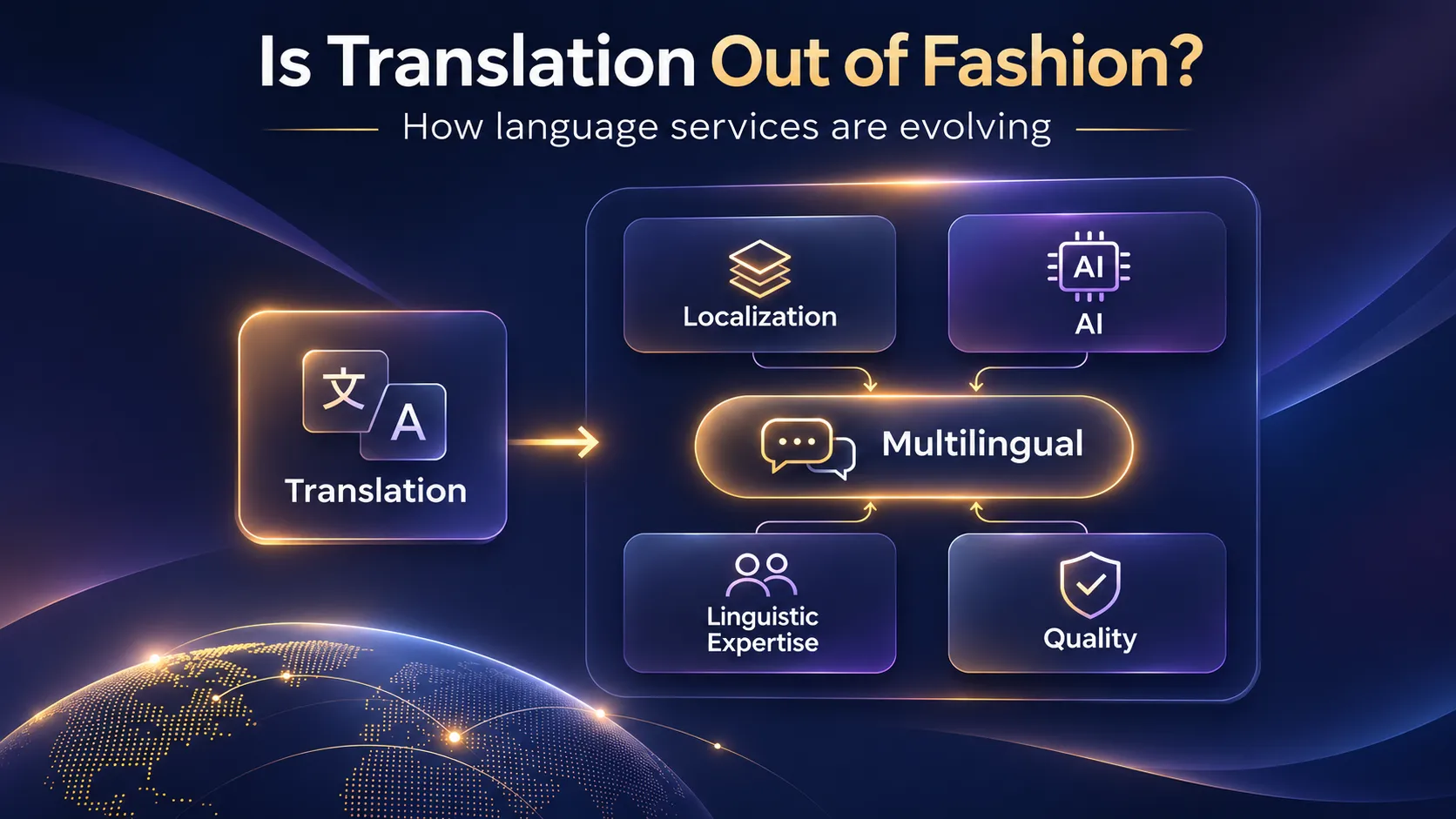
Translation is not necessarily out of fashion. Rather, the way the language industry presents, sells, and understands translation has evolved. The word translation is increasingly perceived as too narrow to describe the complexity and business value of today’s language-related services.
There are several reasons behind this shift.
1. Translation has become associated with a commodity
Traditionally, translation meant converting a text from one language into another while preserving its meaning.
With the development of machine translation, AI, and automated tools, translation is increasingly perceived as a technical, relatively standardized process that can be automated. As a result, the service is often judged primarily by price and speed, rather than by the expertise behind the finished text.
As a result, the word translation sometimes creates the impression that the service is interchangeable and that the main differentiator is cost.
This is particularly challenging for professional language service providers who offer much more than word-for-word translation.
2. Businesses want outcomes, not just translated words
Companies no longer simply want their documents translated. They want to communicate effectively with different markets, audiences, cultures, and stakeholders.
Consider the difference:
| Traditional terminology | Broader business terminology |
|---|---|
| Translation | Localization |
| Proofreading | Linguistic quality assurance |
| Terminology management | Language asset management |
| Transcreation | Cultural adaptation |
| Translation project | Multilingual content management |
| Translation services | Language solutions |
| Translator | Language specialist / linguistic expert |
The new terminology puts the emphasis on the result rather than the linguistic operation.
For example, a company entering the Bulgarian market doesn’t simply need its website translated into Bulgarian. It needs its website to feel natural, culturally appropriate, commercially relevant, and legally compliant in Bulgaria.
That’s localization.
3. Localization sounds more strategic
The word ‘localization’ has gained prominence partly because it captures this wider responsibility. A product entering a new market must do more than speak the local language. Its interface, visuals, messaging, and user experience may all need attention. The packaging and campaign examples below illustrate how adapting for an audience can involve choices that go beyond a direct rendering of the original words.
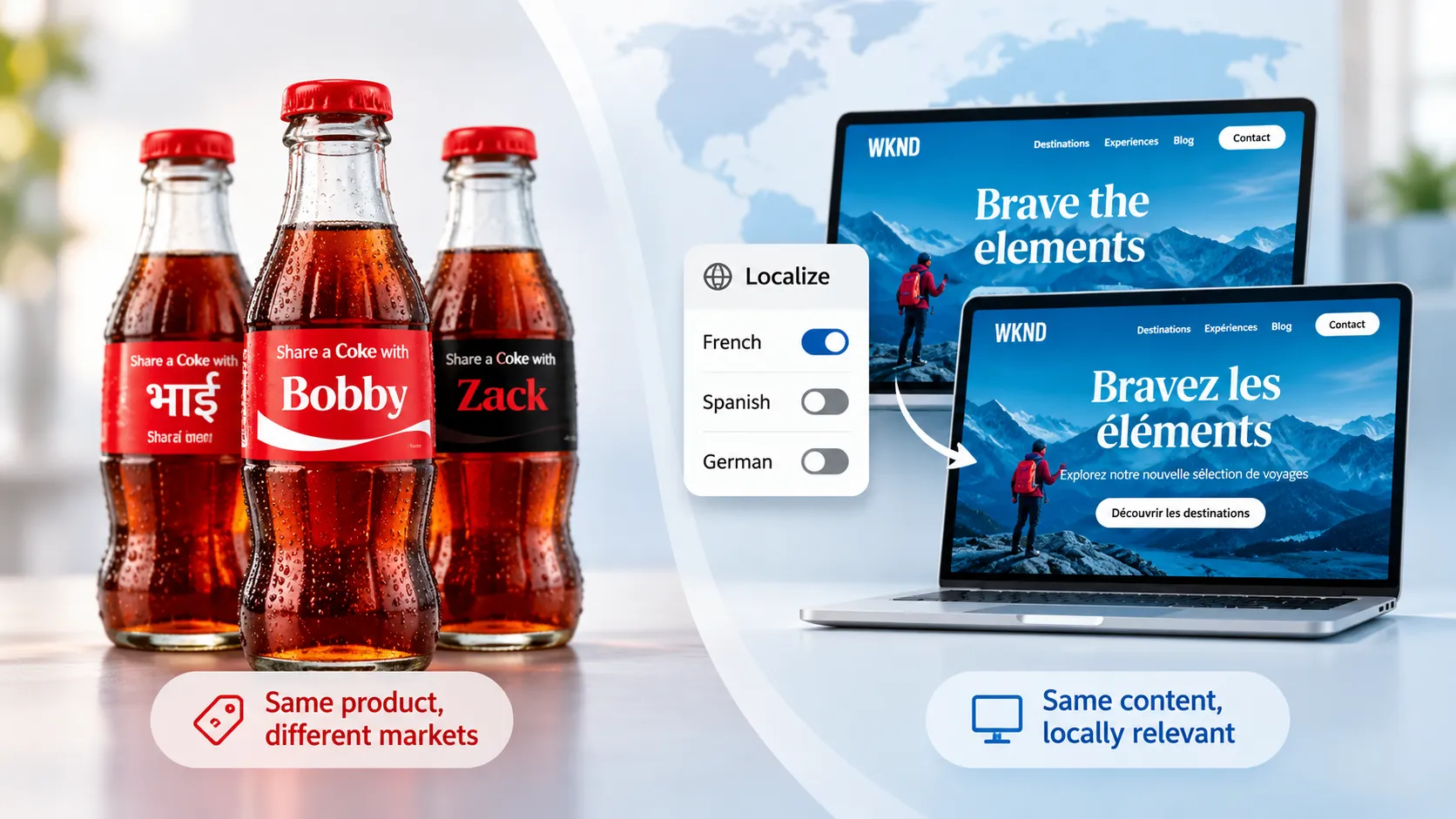
Localization encompasses several dimensions:
- Linguistic: grammar, terminology, style, tone and meaning.
- Cultural: references, humor, conventions and sensitivities.
- Technical: interfaces, formats, character sets and software compatibility.
- Commercial: market expectations, customer behavior and brand positioning.
- Regulatory: local legal and industry-specific requirements.
It therefore positions language professionals as contributors to international business development, rather than simply providers of translated text.
4. AI has changed the industry’s vocabulary
This is perhaps the biggest reason for the current shift.
AI can generate translations, but businesses still need professionals who can:
- Evaluate linguistic accuracy.
- Detect contextual and cultural mistakes.
- Ensure consistency with brand identity.
- Validate terminology.
- Assess sensitive or high-risk content.
- Adapt machine-generated content to its intended audience.
This has encouraged terms such as:
- Linguistic expertise.
- Language intelligence.
- Multilingual content management.
- AI translation post-editing.
- Language quality assurance.
- Human-in-the-loop language services.
The professional is increasingly presented as an expert who manages language quality and communication outcomes, not merely someone who translates.
5. It’s also a question of positioning and perceived value
There is a marketing dimension to this evolution.
Compare these two statements:
Statement A:
“We provide professional translation services.”
Statement B:
“We provide multilingual communication solutions, combining linguistic expertise, cultural intelligence and localization to help organizations communicate effectively across markets.”
The second statement:
- Sounds more comprehensive.
- Communicates greater expertise.
- Moves away from price-per-word comparisons.
- Speaks the language of business decision-makers.
- Creates room for higher-value services.
However, there is a potential downside: sometimes the industry uses sophisticated terminology to repackage essentially the same service.
Not every translation is localization, and not every translation requires transcreation or cultural adaptation.
6. So, is translation becoming obsolete?
Absolutely not.
Translation remains the foundation of the language industry. What is changing is its positioning within a much broader ecosystem.
How the industry is evolving
| Concept | Description |
|---|---|
| Translation | The transfer of meaning between languages |
| Linguistic expertise | The knowledge, judgement and quality assurance behind language |
| Localization and multilingual communication | The adaptation of content, products and experiences to different markets |
Our perspective
We think the industry is experiencing a repositioning rather than a disappearance of translation.
There is also a risk of going too far in the other direction. If we stop using the word translation, we risk making an essential professional discipline invisible.
Translation describes what we do. Linguistic expertise describes the competence we bring. Localization describes the broader process. And multilingual communication describes the business outcome.
These concepts complement one another; they shouldn’t necessarily replace one another.

